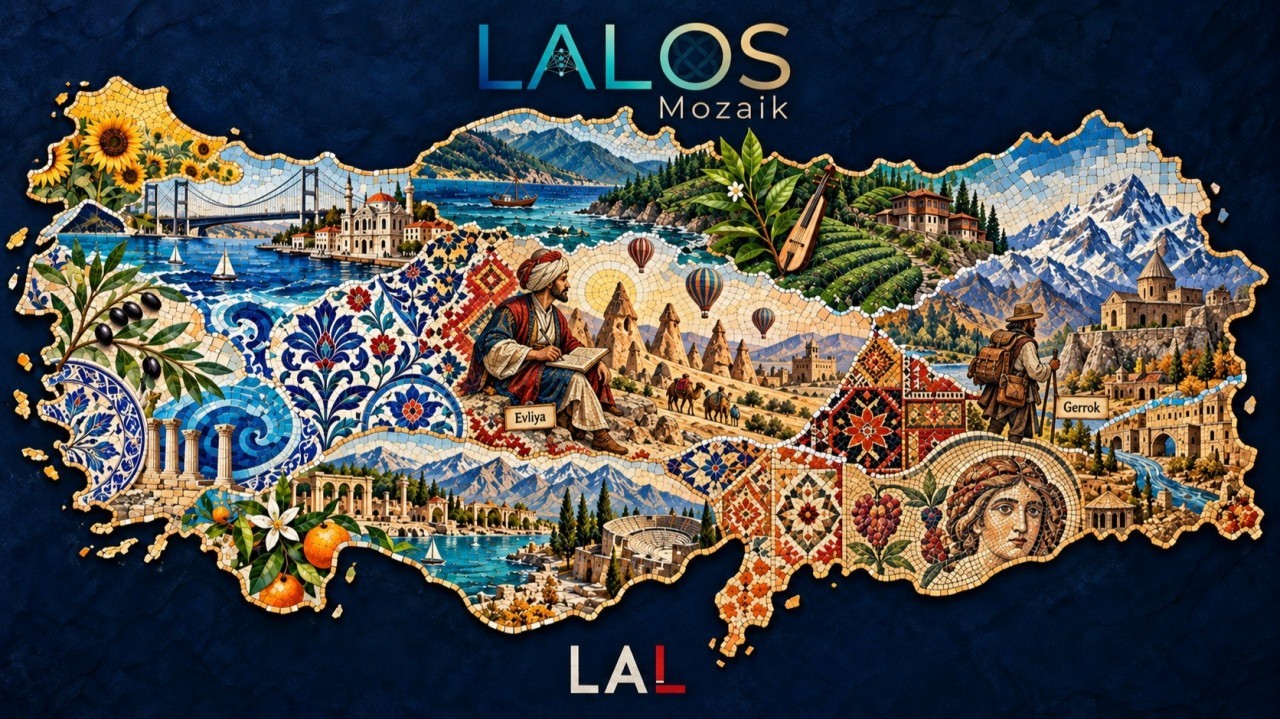
The Name, Language, and Freedom of an Operating System: The Thought Behind LAL OSWhen developing an operating system, the first question is often “Which kernel do you use?” For LAL OS, our answer is clear: we are not developing a distribution built on Linux or BSD. We are trying to build our own architecture from the kernel to the file system, from the graphics infrastructure to the desktop. But for us, a second question is just as important as the first: If we are developing our own operating system, why not feed its language and appearance from the geography we live in? The names of LAL OS were born from this idea. Names are not an ornament, but the narrative language of the system, LALAL, evokes a precious stone. It also connects with silence in our language: “Silence is golden if the word is silver.” There is a visual play on the letters of the name; when the bottom line of the last L is removed, L.A.L approaches the L.A.I appearance. This is a typographic thought that we have embedded in the project rather than claiming its dictionary meaning. LAL OS Mosaic- > Motif - > Reflections from Anatolia Mosaic is the name of our desktop. The visual heritage ranging from the tiles of Kütahya to the mosaics of Kahramanmaraş and Hatay gives us a strong idea: When separate pieces come together, a functional and unique whole can be formed. Today's appearance of the mosaic desktop is not the final version. We want to develop the colors, patterns and themes of the interface in a deeper relationship with the aesthetics of this geography over time. kutahya.ktb.gov.trGerrok is the name of our file explorer; it feeds on the association of travel in Kurdish. Our Evliya browser refers to Evliya Çelebi, who travels around and tells what he sees. Peyk gives its name to our mail server and client in the journalistic sense. Motif, on the other hand, is the name of the programming language we started to develop: In Anatolian rugs, the pattern carries the idea that the code is woven into the loop, just as the loop is woven into the loop. kygm.ktb.gov.trThis approach is also seen in user roles. In LAL OS, we use the Master, Kalfa and Apprentice sequence instead of the usual "Admin" naming. We also want to give small tools that will be developed in the future names that establish a connection between their tasks and their meanings. Trace for an event recording tool, Chest for backup tool, Compass for aid tool can be considered. These are not a list of completed applications today; they are examples of the naming direction we want to follow. Anatolian is not a single color, a single language. We do not want to limit the visual identity of LAL OS to a single tradition. We consider theme options ranging from Kütahya tile to the colors of the Aegean, from the textures of the Black Sea to the motifs of different regions. The same approach extends to language. Local dialects of Turkish, Laz, Kurdish and other languages spoken in Anatolia can inspire naming, localization and cultural design studies. We want to work with people who live and study them for the correct use of these languages. The contribution of designers, language researchers, artists and developers can carry this idea from a superficial visual theme to a real user experience. The goal here is not to randomly paste old words into technology. To establish a meaningful relationship between a function and the word describing it. That's why the names of the application that browses the files, the service that carries the news, and the language used to generate code are important. Freedom: The freedom model we think of for a single system, multi-developer OS, is not based on producing many separate distributions that have lost control. Our goal is to produce a large number of developers on a single official system architecture. QBS assumes the engineering responsibility of the kernel, basic services and official updates. Developers can review the code and suggest bug fixes and features. The contributions to be included in the official version are examined, tested and go through a publication process with a justification. Application developers, on the other hand, can produce software for LAL OS; while distributing their software for free, they can offer installation, adaptation or technical support services. Approval of an application in the official catalog and the ability of a developer to publish its own application are separate issues. The user should be able to clearly recognize the software that QBS examines; independent developers should also have the opportunity to produce it.We want to give the right to words about open source. Viewing the source code alone is not enough for open source; rights to use, modify, and redistribute are also defined by the license. For this reason, which components of LAL OS will be opened under which conditions is the part of the model we have developed that needs to be clearly decided. Today, we're describing a direction and method-we don't make the unpublished code look like it's been published. Open Source InitiativeOpening a new doorLinux has shown many developers that a different path is possible. We respect that labor. What we want to do with LAL OS is to open another way with our own kernel, our own applications, our Motif language and our design understanding fed from Anatolia. This work will not only grow on the shoulders of those who write code. Technical critics, those who demonstrate the correct use of a word, theme designers, application developers and those who explain the working system to others are also needed. You can watch the development of LAL OS from our videos, subscribe to our channel, share our work and participate in the discussions in our community. Freedom is strengthened when the ways people can understand, develop, and choose multiply.Independent operating system, operating system development from scratch, kernel development, digital sovereignty, software freedom, open source development model, developer ecosystem, programming language development, Anatolian design, cultural heritage, user experience, localization, operating system architecture.LAL OS Mosaic Preview Videoshttps://youtu.be/Nx x8SxZXHuQhttps://youtu.be/qyiDP6nJLuo#OperatingSystem#NativeTechnology#DigitalSovereignty#SoftwareDevelopment#OpenSource#OperatingSystems#KernelDevelopment#AnatolianCulture#LALOS
The Name, Language, and Freedom of an Operating System: The Thought Behind LAL OS
The Name, Language, and Freedom of an Operating System: The Thought Behind LAL OS
Yorumlar
2 yorumGüzel bir yazı olduğunu düşünüyorum.
@tcelik3217 Teşekkür ederiz tarık bey